


7 Oct 2025
Elements of tax fraud alleged at Durango Dance & Cafe au Play

Current and former employees of Durango Dance and Cafe au Play, two organizations in Durango, Colorado, have expressed their concerns with possible tax fraud occurring there related to payroll and fundraising.
 Specifically, at Durango Dance, former employee Melinda (Harmony) Morris alleged that her boss, Miriam Morgan paid Morris from Morgan’s personal account on Venmo. Then, after Morris separated from her job at Durango Dance, Morris alleged that Morgan sent her a W-2 that didn’t look accurate. However, since Morris had not received any regular payroll stubs, Morris only had screenshots of her Venmo transactions to compare to her data from the W-2 provided by the IRS, said Morris.
Furthermore, Morris alleges that the Venmo payments she received from Morgan did not reflect her regular hours worked or her overtime hours worked.
“I questioned her about the hours missing right before I got my hours cut back to nothing and shit canned,” said Morris.
Another former employee of Durango Dance told me that her actual earnings did not match up with the earnings reported on her W-2, she said.
Durango Dance Foundation is an incorporated Non Profit Corporation in the state of Colorado that received a grant of $6,688 dollars in 2024 from the City of Durango’s Lodger’s Tax Arts and Culture tax. It was awarded to go towards 15 summer camp and fall dance scholarships.
Cafe au Play board member solicited funds under false pretenses
An employee of Cafe au Play, a fiscal project of a non profit organization in Durango, also expressed concern about the co-founder fundraising with the co-founder’s personal Venmo account under the pretense that she was fundraising for Cafe au Play.
Kelly Tregillus, the co-founder of Cafe au Play, appears to have posted a flyer with a QR code on it for people to use to make a donation to the organization.
Deceivingly, the QR code was actually a link to Tregillus’ personal Venmo account, not the account of Cafe au Play. Tregillus’ initials were in the middle of the QR code, but the title to the flyer said, “Scan to Donate To Cafe au Play.”
It appeared that Tregillus was soliciting donations to her personal bank account under the pretense that the donation would be going to the bank account of Cafe au Play. Seems a little bit misleading for a fiscal project that is supposed to be directing donations to its fiscal sponsor, The Community Foundation of Southwest Colorado.
The fundraising flyer was taken down after I started asking questions about the legality of it.
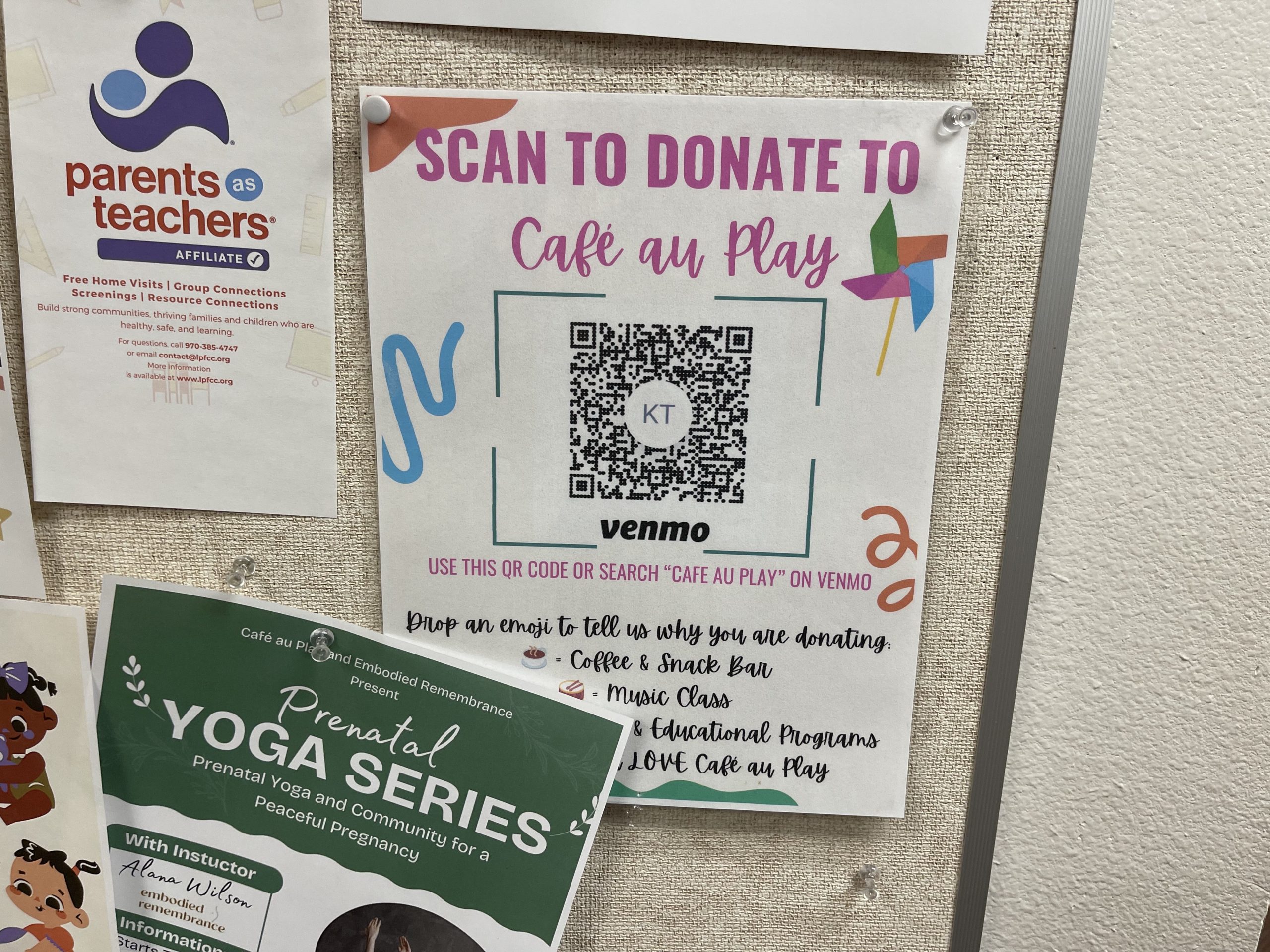
 Before getting caught soliciting funds under false pretenses
 After getting caught soliciting funds under false pretenses
Elements of payroll tax fraud under Colorado Statutes
In Colorado, the primary element of payroll tax fraud is willful conduct, which differentiates criminal tax fraud from a simple mistake. For prosecution, authorities must prove a deliberate and intentional effort to evade or defeat tax obligations.
Based on Colorado Revised Statutes and legal interpretations, the elements for a criminal charge of payroll tax fraud include:
- A duty to act: The accused must be a person or entity required by law to collect, account for, and pay over payroll taxes. This includes corporate officers and responsible parties.
- Willful failure to act: This is the most critical component, involving a conscious and deliberate decision to not perform the required duties. Indicators of willful intent can include:Concealing income and using false Social Security numbers.
- Keeping two sets of books to misrepresent financial details.
- Making false or fraudulent statements on returns or in connection with a refund.
- Falsifying documents.
- Repeatedly or intentionally failing to pay taxes or file returns.
- A fraudulent act or omission: The willful failure must be coupled with an affirmative fraudulent act or omission, such as one of the following:Willfully failing to collect, account for, or pay over tax.
- Willfully attempting to evade or defeat any tax.
- Filing a return, affidavit, or claim that is known to be false as to any material matter.
Examples of fraudulent activity
The Colorado Department of Revenue and legal sources cite the following examples of actions that demonstrate willful conduct:
- Pyramiding: Withholding taxes from employee wages and intentionally spending the money instead of remitting it to the state.
- Off-the-books payments: Paying employees in cash and not accurately reporting the wages to avoid paying payroll taxes and workers’ compensation premiums.
- Falsifying records: Creating false timecards or payroll information to lower the reported tax liability.
Concealing assets: Hiding or transferring assets to prevent tax authorities from collecting overdue taxes.
Penalties for tax fraud
Criminal payroll tax fraud is a serious offense in Colorado, and a conviction can result in one of the following penalties:
- Class 5 felony: For willful failure to collect, account for, or pay over tax.
- Class 6 felony: For any willful attempt to evade or defeat a tax.
- Fines: Up to $100,000 for individuals and $500,000 for corporations.
- Imprisonment: Up to three years in prison.
- Personal liability: For corporate officers or other responsible parties, the Colorado Department of Revenue and the IRS can hold them personally liable for the unpaid trust fund taxes.
- Collection actions: The state can place liens on assets, garnish wages, and seize property.
Elements of charitable tax fraud in Colorado
Under Colorado Revised Statute 6-16-111, a person commits charitable fraud if he or she engages in one of the following (non an exhaustive list):
- (g) With the intent to defraud, devises or executes a scheme or artifice to defraud by means of a solicitation or obtains money, property, or services by means of a false or fraudulent pretense, representation, or promise in the course of a solicitation. A representation may be any manifestation of any assertion by words or conduct, including, but not limited to, a failure to disclose a material fact.
- (i) Represents or causes another to represent that a contribution to a charitable organization will be used for a purpose other than the purpose for which the charitable organization actually intends to use such contribution;
- (j) Represents or causes another to represent that a greater portion of the contribution will go to a charitable organization than the actual portion that will go to such organization;
Here’s what the statute says about the penalties for charitable fraud:
- (4) Charitable fraud which is a felony shall be deemed a class 1 public nuisance and subject to the provisions of part 3 of article 13 of title 16, C.R.S.
- (5) Violation of any provision of this article also shall constitute a deceptive trade practice in violation of the “Colorado Consumer Protection Act”, article 1 of this title, and shall be subject to remedies or penalties, or both, pursuant thereto.
- (6)(a) In addition to any other applicable penalty, the secretary of state may deny, suspend, or revoke the registration of any charitable organization, professional fund-raising consultant, or paid solicitor that makes a false statement or omits material information in any registration statement, annual report, or other information required to be filed by this article or that acts or fails to act in such a manner as otherwise to violate any provision of this article. The secretary of state may also deny, suspend, or revoke the registration of any person who does not meet the requirements for registration set forth in this article.
- (b) Upon notice from the secretary of state that a registration has been denied or is subject to suspension or revocation, the aggrieved party may request a hearing. The request for hearing must be made within thirty days after the date of the notice. Proceedings for any such denial, suspension, or revocation hearing are governed by the “State Administrative Procedure Act”, article 4 of title 24; except that the secretary of state shall promulgate rules to provide for expedited deadlines to govern such proceedings and shall bear the burden of proof. The status quo concerning the ability of the aggrieved party to solicit funds is maintained during the pendency of the proceedings. Judicial review is available pursuant to section 24-4-106.
- (c) In addition to other remedies authorized by law, the secretary of state may bring a civil action in the district court of any judicial district in which venue is proper for the purpose of obtaining injunctive relief against any person who violates, or threatens to violate, the provisions of this article.
- (d) The rights and remedies available to the secretary of state pursuant to this subsection (6) shall not affect the rights and remedies available to any other person seeking relief for violations of this article or any other applicable law.
Adam Howell is a writer who believes in free press and the importance of the constitution. He can be reached by clicking on this link to the contact page.


